
A New Enemy
- Christine Kyte

- Jan 19
- 3 min read
We have found a new enemy.
Sea Fire has a steel hull and was made for expedition sailing in cold climates. She has an excellent diesel heater and is incredibly well insulated. Unfortunately, all that insulation does not extend to the windows, and when you put a warm inside against a cold outside with an excellent conductor and start cooking and - heaven forbid - breathing, you get the delightful occurrence of condensation.
With temperatures hovering between 0 and 5 Celsius we had experienced some drips from the hatches and the large wrap-around window in the galley (kitchen), but recently it has dipped below zero with some biting winds.

Jean and I have stayed roasty toasty in our bed, but two mornings ago we woke up to a thick layer of frost on the bottom of all our wrap-around windows. It took all day to melt and plenty of kitchen towels to mop up, leaving us wondering how we were going to deal with it moving forward, and what damage could it cause if we didn't learn to manage it.
During the move-in and clean process (still not done yet, the place is filthy), several pieces of malleable foam were spotted - obviously cut to fit in the windows. Assuming these were part of our solution I began tracking them down.

Jean was in the middle of a maintenance day with a mechanic from Safe Harbor Marina where we are docked, so I began tearing the place apart. Sailboat makers are incredible in their use of space. Every spare centimeter not needed for systems (engine, bilge, heater, etc) are utilized for storage. That means there are storage areas hidden behind seat cushions, under seats, beneath floor boards and under beds. In a cubby behind a seat in the salon was the mother lode of foam cutouts, but a few were still missing.
I flipped up the mattress on our bed and opened up the three compartments underneath hoping to find the missing foam but instead saw that condensation from the hull had generated moisture with nowhere to go except into our mattress. The beginnings of mold were on the mattress cover and it was damp to the touch in all areas that sat over top the compartments.
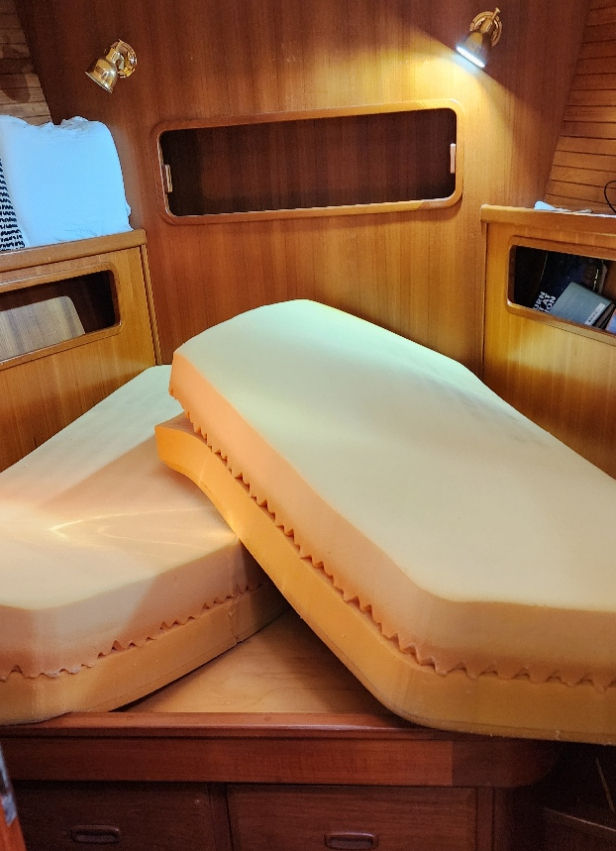
Panic. I ripped off the bedding, took off the mattress cover, cut open the thin fabric cover, and flipped the mattress halves (it's a two piece foam mattress). Thankfully there was no mold on the foam, only the mattress cover. I turned on the fans and aimed them at the damp spots, then began fitting the foam cut-outs to the windows.
Since the discovery, we have begun a three-pronged approach to managing condensation. First, we are reducing the moisture in the boat. Tea is made in the microwave, food is cooked with the lid on the pot or pan, and we have a tabletop dehumidifier that runs all the time.
Second, we have increased airflow. Fans run when we are cooking and the hatch is opened when temperatures allow - letting moisture out instead of collecting on our windows. And third, we are managing our surfaces. Foam over the windows and insulation sheets in the hatches cover up the spaces water can condense.
There are still drips. We have lost most of the natural light in the boat, and I’m putting the laptop IN the desk rather than atop it - just in case the drips get bad - but its improved immensely.
Another case of “you don’t know what you don’t know,” and more learned about living on a boat.

-Christine



AH you guys seem busy allready hope your sailing begins soon