
Water. A Complicated Relationship
- Christine Kyte

- Feb 8
- 5 min read
The last few weeks have seen us fall into a somewhat easier routine since we gave up our rental car. With each day being so mentally and physically exhausting we have been sleeping 10 hours, enjoying a slower morning and then starting “work” around 9am. With our priority repairs and maintenance (from the survey) completed, we now work on regular maintenance and knowledge items like checking and cleaning valves, learning where pipes and hoses lead, and familiarizing ourselves with navigation software.
One problem that keeps cropping up in different forms is water. It's our vehicle, the medium through which we travel (or will travel), but the water around the boat is frozen, preventing our departure. The pressure relief valve on the hot water tank is leaking - so no hot water until a replacement part arrives from Washington. And then the watermaker was leaking and making a sound it's not supposed to make - leaving us hauling water from the marina taps again.


A week ago we thought we had the watermaker figured out. After de-winterizing it we ran it a few hours each day, and the water continued to reach lower salinity daily until it stalled at 510 ppm of Total Dissolved Solids (TDS), a fancy term for salt. Spectra brand watermakers (what we have) are famous for producing water with TDS levels below 150ppm, and ours not dropping below 510ppm led us to guess that our membrane (the reverse osmosis filter) had failed. At $250USD for an off-brand replacement ($700 for a Spectra membrane), and an incredibly challenging replacement process due to access to the membrane housing, we wanted to be sure the membrane was the problem before moving forward.
Spectra tech support suggested a variety of tests to diagnose the issue before purchasing a membrane. One of those was determining our flow-rate, so we turned both pumps on and checked the flow rate and salinity. The salinity dropped to 350ppm in a matter of minutes! We had only been using one pump before and guess that there was a buildup of salt on the membrane from it sitting without use prior to us moving aboard. One pump didn’t generate enough pressure to clear out the buildup but two pumps did. After an hour we were at 250ppm but had to stop with the tide going out. Watermakers should be run in open water to reduce sediments, we are in a marina so to lower our chances of clogging the filter and membrane we have been running it on the flood tide.
We were told to run the watermaker for several more hours to clear the salt and bring it to a low ppm, so the next day we turned it on. Shortly afterwards a squealing sounded on each direction change of the pump, alongside water seeping out of the face plate at the “thump” after each direction change. The thump is normal, the squealing and water seeping is not.
Back to the drawing board. Miraculously, YouTube had an answer. Spectra’s channel had a video walkthrough of a repair for our exact leak. It looked like the Valve Bore O-rings had failed. The O-rings were likely quite old, perhaps even from the 2020 install, and brittle. When we ran the pump with -2C water (quite a bit lower than the recommended operating temperatures of 2C-35C), the brittle O-rings became more brittle and failed completely. We suspected the squealing sound was coming from the pistons, as the sound only occurred when the pistons were moving. A video of a full Clark Pump rebuild (the main unit for the watermaker) showed how to access the pistons and check them for damage. Now we just needed replacement parts.
We had been considering purchasing a package of replacement O-rings that Spectra sells but hadn’t pulled the trigger yet due to the cost. $175USD for a package of 30 tiny rubber doughnuts seemed ridiculous but unfortunately we didn’t see an alternative now.

But wait a second! Our spare parts inventory included hundreds of bits and pieces for various boat systems, all catalogued in detail with part numbers and descriptors… except for the Spectra parts. Two boxes full of filters and other bits were glanced at and simply noted as “Watermaker”, with no detailed inventory. It was time to dig out the boxes and take a look. We struck gold. 2 full “Offshore Rebuild Kits,” complete with O-ring packages were found, with only one or two pieces missing from the whole kit. The necessary O-rings were set aside, food grade silicone grease located, and the next day earmarked for Mission Watermaker. Disassemble the Clark pump, replace all O-rings between the blocks and cylinders, and examine the pistons to see if something was wrong. I didn’t sleep well that night.

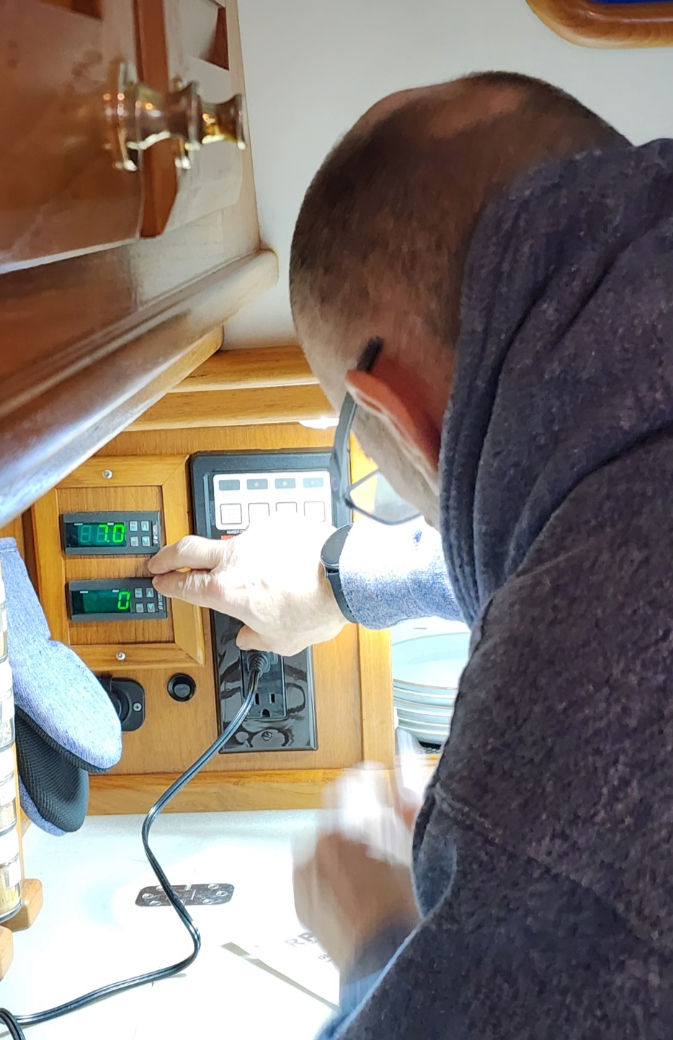
The next day we closed the sea valve for the watermaker (the hole in the boat where the watermaker gets water to desalinate) so sea water couldn’t come uncontrolled into the boat, then got to work. The space is incredibly cramped. Crawl under the steering column and around the corner, wiggle your upper body between the transformer and “roof,” then disassemble the unit. This photo shows me working on the side of the pump with easier access.
We took turns in the cramped space and over 4 hours managed to change all the O-rings and examine the piston. All the O-rings were flattened and one had completely failed, and one piston had 3 small pieces of metal embedded in the plastic. We removed them, smoothed out the plastic to the best of our ability, and re-assembled the pump.


After our reassembly, Spectra returned my email, suggesting a full rebuild of the pump if we were already taking it apart for the O-rings. This is a much more involved process than our completed repair, but likely something we will need to look at in the coming years. They also had no idea where the metal shards could have come from.
Unfortunately, we can’t test it right away. Although Spectra tech support says the pump should work fine as long as the water doesn’t freeze inside it, we are concerned that the extremely cold temperatures will just cause more problems. This coming week will see warmer temperatures and we will see.
Now we need to source out a piston head as the damaged one should be replaced as soon as possible. This is actually quite difficult as Spectra doesn’t ship parts directly, only through distributors. And the distributors have proven quite challenging to deal with.
So the water saga continues, with our hot water tank’s pressure release valve arriving on Wednesday… and just now the freshwater pump has started making a sound it's not supposed to make. Damn it.



Comments