

La Poile, Newfoundland

Time to go. Today we leave our beloved Rose Blanche and are bound for La Poile (pronounced La Poyle, like foil). The morning is calm and sunny, with the barest breeze pushing us off the dock - ideal conditions. Upon exiting the harbour the only thing we could ask for is wind. It takes 9 knots to get Sea Fire going under sail power and we only have 4 knots so we kick our feet up and settle in for a comfortable and short motor to our next destination, letting Simmy, our autopilot, take the helm.
We are 30 minutes from our destination and the sea floor is 190 feet away from our hull, time to try jigging for cod. We turn off the engine and drop our cod jigger, but the boat is still moving too much for the jig to get deep enough - a key part of the process. Cod swim about 10-15 feet above the sea floor so you weight your line, drop it down till it hits bottom, lift it up 10-15', and then jig until you catch something. After 2 attempts and not keeping still enough to drop the lure straight down we pull it up, start the engine and keep going. On the weekend we will try jigging in the dinghy (cod fishing is open Sat-Mon), hopefully with better luck.
A prudent and prepared skipper, Jean has 5 potential spots picked out for us, all with southwest protection to wait out the blow starting tomorrow (Tuesday). After reconnaissance of a couple of spots that end up being last-resort options in La Poile Harbour, we head to Little Bay where the public/government wharf is. On our way to the wharf we spy SV Kokoum tied up at the derelict wharf on the opposite side of the bay as the working wharf. We slow down and exchange hellos with Bert and Francois, finding out they didn't fix the malfunctioning transmission that had jammed at 6 knots (10 km/hr), this is very fast for a sailboat. They are bound for Culotte Cove and would be leaving right away if we wanted to dock in their spot. It's solid, they say, just dont step on the dock as the boards are rotten.
A few turns around the end of the tickle (a small branch off the main fjord) to scope out the anchorage and we head back to the wharf, stopped by a fishing buoy that potentially had a line across the tickle. We agree that the derelict wharf is a good spot, as the incoming winds would push us off the dock (rather than press us into it, potentially causing paint damage) and we will be more comfortable than at the public wharf. Docking goes fine, but the wharf is quite a bit more run down than expected. I'm not feeling good about it, but its now 1:30pm and I'm hungry and cranky with it. I suggest we eat before deciding anything.
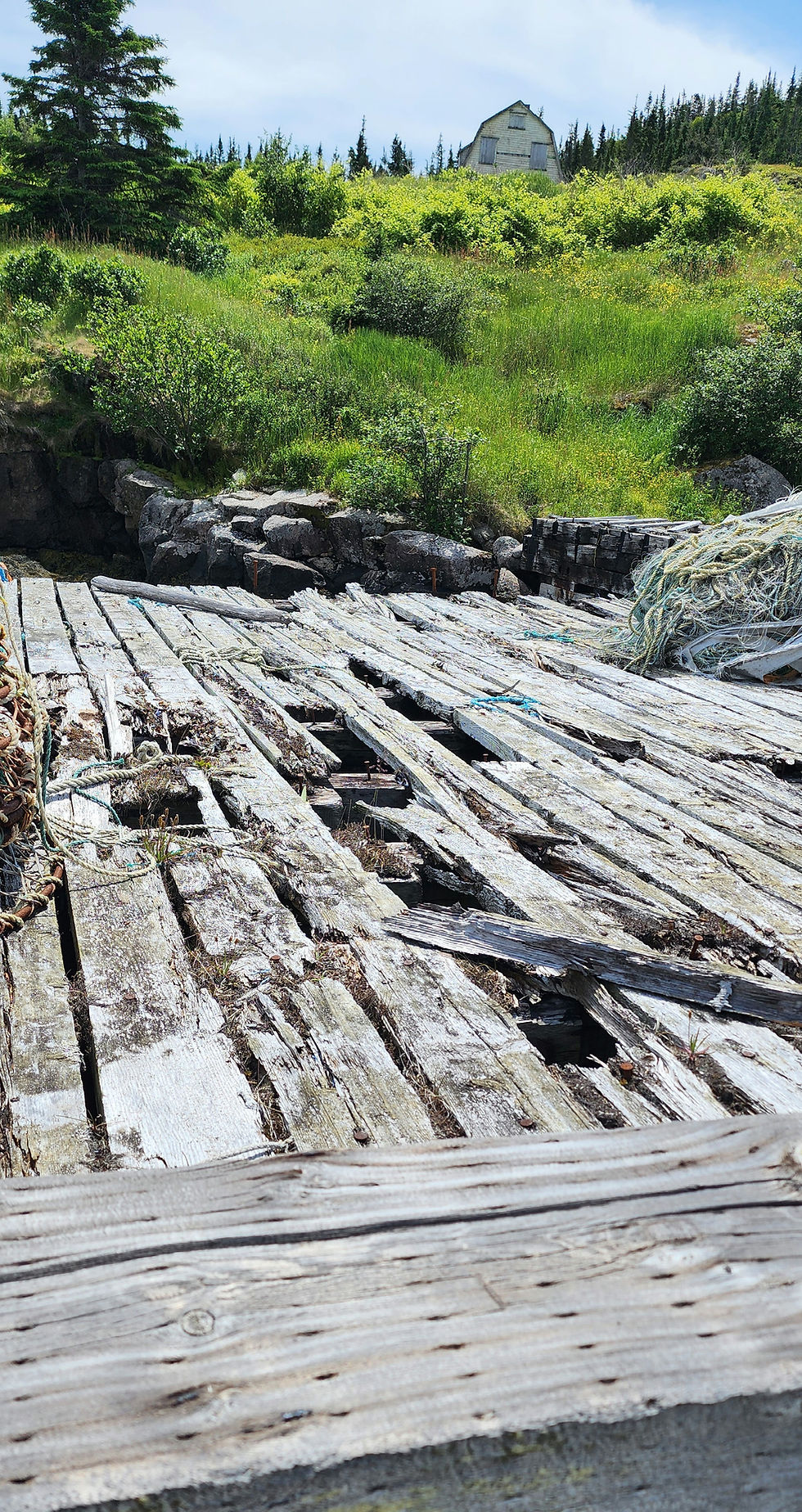
We aren't staying here. Too sketchy. Lunch is finished so we slip the lines and shove off, heading towards the public wharf. It's in excellent shape but small at 70 feet long. Sea Fire is 47 feet leaving no space for another boat and we are lucky its empty. Jean approaches at a 90 degree angle to the dock, heading straight for it, and turns when we are 20' away, giving a blast of reverse to kick the stern to the left and bring us parallel to the dock. We get very close but not quite close enough for me to step off and secure the lines, the light wind pushing us off the dock was of no help. Jean motors out and changes tactics, approaching the dock in reverse, like parallel parking. A beautiful manoever and we are alongside the wharf, close enough for me to (almost leisurely) step onto the dock and climb the ladder with the spring line to secure the boat. With the spring line secured Jean motors forward a bit and Sea Fire comes in tight to the dock. He passes me the bow and stern lines and we are done. Quick, smooth, flawless. Perhaps... PERHAPS this docking thing is getting a tiny bit easier with practice.
Everywhere else we have docked there has been someone hanging around, worker or not, that has caught our lines. Here there is noone. The dock is in good repair but there are building supplies and bits of garbage around, and the outdated ferry schedule is faded and peeling. Looking around we see sheds surrounding the wharf that are crumbling away and slanted sideways. If not for the sound of a whipper snipper running it would appear to be a ghost town. There is no shore power to plug into here, but also no docking fees. We take our blessings where we find them.
We complete our dock chores - repositioning ropes (halyards) so they don't make noise in the night, covering the mainsail to prevent UV damage, and bringing equipment belowdeck - and Jean goes down for a nap. I grab my book, the fishing rod, and a bottle of water and head to the cockpit.
One of my personal goals for our time in Newfoundland is to experience the culture through meeting people and making friends. I have a hypothesis that the fishing rod is a sort of social lubricant that can lead to easy conversation, like smoking but healthier. You are standing around doing something, have an instant topic of conversation (hows the fishing around here? Can you catch any off the wharf?) And casting allows for the conversation to have gaps in it without being awkward. I will share my findings as I test the hypothesis.
First, I decide to take a break. Out comes the cushion and I sit down to read for a bit. Two minutes later an ATV comes up and stops at the boat.
La Poile (pronounced La Poyle - rhymes with foil), has no roads that lead to it, and is only accessible by boat or quad/snowmobile trails. Because of this, the town has no cars and no roads, instead, wide cement "sidewalks" go through the town, and people drive ATVs/quads. Prior to the fisheries closing down La Poile was a busy place with some 200+ residents. Today only a quarter or less of the homes are populated with the 51 full time residents. There are no stores and the only services are a ferry traveling to Rose Blanche and back, and a post office. On the wharf is an outhouse with "public washroom" written in red paint, the toilet seat open to the water below. The government took away their incinerator for garbage and now they burn it themselves at various places outside town. Its a conservative place and the people are friendly but mostly keep to themselves. The town itself feels a bit desolate, you can sense the ghost of what it used to be and talk quietly to avoid disturbing anyone or drawing attention to yourself. Laughter feels out of place here, where people are just trying to get by.

I wave hello to the curious ATV and after pleasantries ask if there is any good fishing off the wharf. Carl says mackerel has been caught, also cod and halibut on the rare occasion. I climb up to the wharf, fishing rod in hand (a big climb as the wharf is huge - Sea Fire is 12 feet lower than the top and I use the ladder to get up after pulling the boat closer with the spring line). I chat with Carl and he tells me about the town, the ferry that goes between La Poile and Rose Blanche, and the wharf. I tell him where we've been and where we're headed, that we docked across the bay at the derelict wharf but changed our minds and came here instead. During our chat Jean joins us, and at the next conversation lull I tell him that mackerel fishing is good off the dock. Jean asks about squid and Carl responds, "Oh yes me son, happens occasionally but sooner to get em over there and there," pointing at various spots across the bay, telling a story of fishermen at night shining a light on the water to find the squid.
He heads home but will be back in an hour to help the ferry dock, and asks if we've had halibut. We respond that we've had it and we love it. Carl is going to bring some back for us. We protest and then thank him as he won't be swayed.
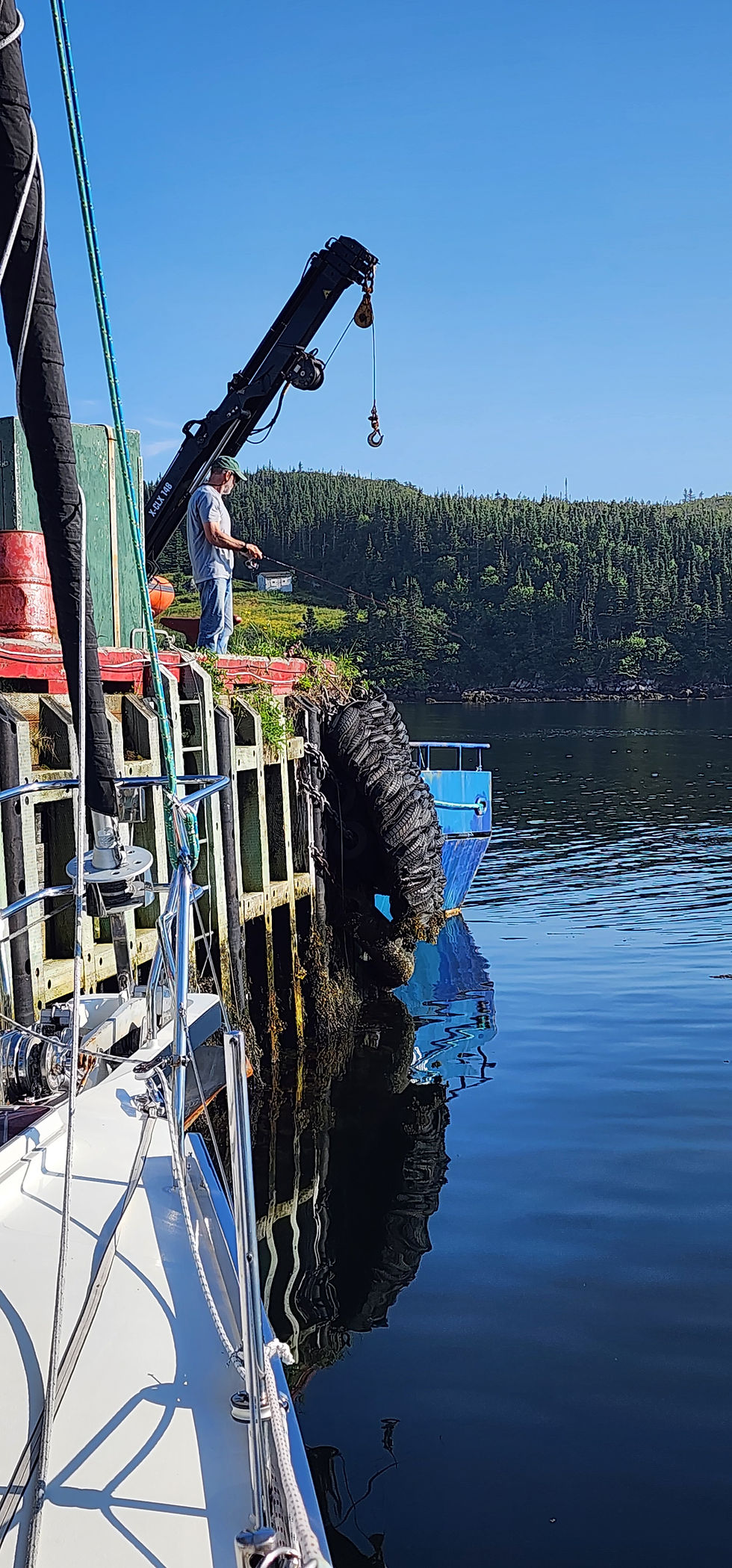
Quite a few casts and no mackerel have us back on the boat planning supper when Carl comes back in his ATV, handing over a full grocery bag. We pull the items out as he tells us what they are. Ground moose, halibut filets, halibut cheeks, frozen partridgeberries, a jar of cooked cubed moose, and a jar of lobster meat. We tell him its too much but of course he won't hear it, and he's happy to tell us how to cook the halibut cheeks (dredge in flour and fry them) and the jarred moose (put it in a gravy and heat them up or just eat em cold out of the jar).
Carl invites us over to his home for a visit, saying he will walk up with us after helping the ferry dock at around 5:30pm. We clean up a bit and dig out the lone bottle of wine we have on board (all our wine is boxed - Chateaux Cardboard as my parents say) as showing up empty handed would be insane after his generosity, and rude in general. A short walk, perhaps 500m, and we are at his home hearing stories of the moose that frequent his yard. Colleen, his wife, arrives and we have a lively conversation over a glass of wine. They tell stories of extreme weather and road blockages, kids and grandkids and their accomplishments, work and play and the trials and tribulations of their lives. We tell our own stories of shoveling snow off the boat in Connecticut and sailing in winter. Carl disappears for a few minutes and on his return hands Jean a pouch containing a leatherman multitool with a beautiful wood inlay. It's gorgeous and we both admire the craftsmanship, expecting a story that goes along with it.
"No me son, that's for you." Carl says he doesn't use it and it is absolutely coming with us on our adventures. Colleen disappears and comes back with a little silver trinket ring, telling a story of where she found it and handing it to me. We say we can't accept the gifts, they're too much. Carl and Colleen are firm and will not take no for an answer. Again, we switch to gratitude, letting them know that the items will be well-loved aboard Sea Fire, and will always remind us of them.
Conversation continues and we chat about food, when I ask again about the jar of moose. I can't get my head wrapped around how to eat it and ask if we could put it in stew. Yes, absolutely! Is the response, and now it's a valuable pantry item instead of a mystery. Colleen asks if we've had seal meat, procuring a jar of it and passing it over. We have, but aren't sure how to prepare it. Carl likes it right out of the jar - his eyes light up at the thought and I can tell this is a guilty treat when Colleen gives him the side-eye.
After just over an hour we head on our way, saying we are tired from our travels today. They reluctantly accept this and wish us a good evening. If the weather holds they will leave on the ferry tomorrow for a few days but if not then we are welcome to stop by for a visit.
Back to the boat and again we are gobsmacked. "These people have nothing and still give you the shirt off their backs," Jean says in disbelief. And still the generosity. We do some reading on the topic to ensure we are being respectful and participating appropriately. The internet tells us that there is no expectation of material reciprocity, instead we can give our presence. Listening to stories, telling our own, conversing with joy, and offering simple gestures of thanks such as returning a cleaned jar or sending a note are the highest form of currency we can offer. And with that knowledge we shift our mindset. We will have baked goods on board that we can gift but won't be stressed if it feels one sided.
The morning was overcast but not rainy or windy so we assumed Carl and Colleen headed to Rose Blanche on the ferry, bound for Port aux Basques afterwards. This was confirmed later that day when Carl wasn't there to help the ferry dock. If we leave before they return we will drop off a cleaned jar (the lobster meat has already been consumed) and a thank you note at their home for them to find when they return. And if we see them before we leave, we will stop by for a bit of a yarn (chat) prior to heading on our way. I'm sure there will be a good story of the weather over the last few days and the ferry getting delayed, and I can't wait to hear it.
Jean cracks open the jar of seal meat and makes simple canapes with them. The seal has the texture of braised stew beef - fall apart tender - and the faintest marine flavor. He forks the seal onto a triscuit, spoons a little grainy Dijon on top, and we spoil our supper on the decadent appetizers.
Moose burgers follow the seal canapes. The heavily seasoned meat needs no additional flavour and I only add a few breadcrumbs and an egg, creating some softness to the finely ground moose. Barbequeing is always tricky and I think we have only fired up the grill 4 times. Our tiny Magma grill won't hold a flame if its windy out, and being so small it flares up badly if grease drips onto the element. Also, 2 weeks ago we discovered a crack in the propane line, requiring replacement. Into the pan go the burgers, then onto buns with the usual fixings. Neither of us can remember eating moose before, and we enjoy it thoroughly. Any gaminess is masked by the heavy seasoning (probably steak spice, salt, and pepper), and the texture is just like beef. Its delicious and we can't believe there are 2 more pounds of it in the freezer.
The storm we were waiting out produced nothing but a bit of rain and thunder, and none of the predicted 30 knot winds touched us. A gift of the topography and a good decision to stay here. We guess the weather was ugly further out as the ferry didn’t return the night before as it was scheduled. In the morning locals gather at the wharf, anticipating its arrival and Jean goes outside to get the gossip. The only information anyone has is that the ferry is in good working condition but is delayed. Perhaps it will arrive in the evening.
The weather is mild but foggy, and we discuss leaving for Grand Bruit today, but know that the sea can take some time to calm after a storm and decide to wait until tomorrow, letting the waves come down.
We "clean the house," vacuum with our tiny dustbuster, dust, and put conditioner on the leather salon couches. Jean bakes bread then fishes off the wharf for mackerel, no luck but a nice way to spend an hour. Dinner is going to be fish cakes, made with the remaining cod from Les a few days before, some mackerel filets, and the jar of lobster from Carl and Colleen. They are labor intensive but delicious, and we have enough for 2 meals and tartar sauce to go with them.
The ferry arrives finally and the locals collect their groceries from the crates that have been lifted by crane from ferry to dock. Jean spies a couple exiting the ferry with large backpacks on who head into town. They stand out as much as we do - noone would ever mistake us for locals.
The sun is shining and a walk is in order after dinner. We bring 2 emptied jars back to Carl and Colleen's with a note of thanks in one of them, hanging it on their door knob when its confirmed they aren't there. Several locals are on the ATV paths, all our for their evening walk, the most action we've seen since arriving. We say hello to everyone and beyond a brief and friendly exchange about the beautiful evening, noone seems interested in chatting. We track down the backpackers, a Quebec couple in their 70s who will travel Newfoundland's south shore until the fall. We show them where to find water on the wharf then head back to Sea Fire.
Starlink is turned on for a weather check and we head to bed, anticipating a good wind that will push us the 30 nm to the much lauded Grand Bruit in the morning.


Comments